Tech & Infotainment
Supercomputers on wheels: OTA updates, autonomous driving arrays, and screen domination.
Software-Defined Vehicles (SDVs)
Historically, an automobile was a collection of mechanical systems loosely tied together by isolated microcontrollers. The EV revolution birthed the Software-Defined Vehicle (SDV). In an SDV, a centralized computer architecture governs everything—from the torque output of the rear motor to the heated seats and windshield wipers.
Because the car is fundamentally run by centralized software, manufacturers can issue Over-The-Air (OTA) updates over cellular networks or Wi-Fi. This means that unlike an ICE vehicle which is as good as it will ever be the day it rolls off the lot, an EV can literally improve over time. OTA updates have been used to optimize battery thermal management (yielding extra range), increase motor power outputs, and add completely new infotainment applications while the car is parked in your garage.
The Screenification of the Cabin
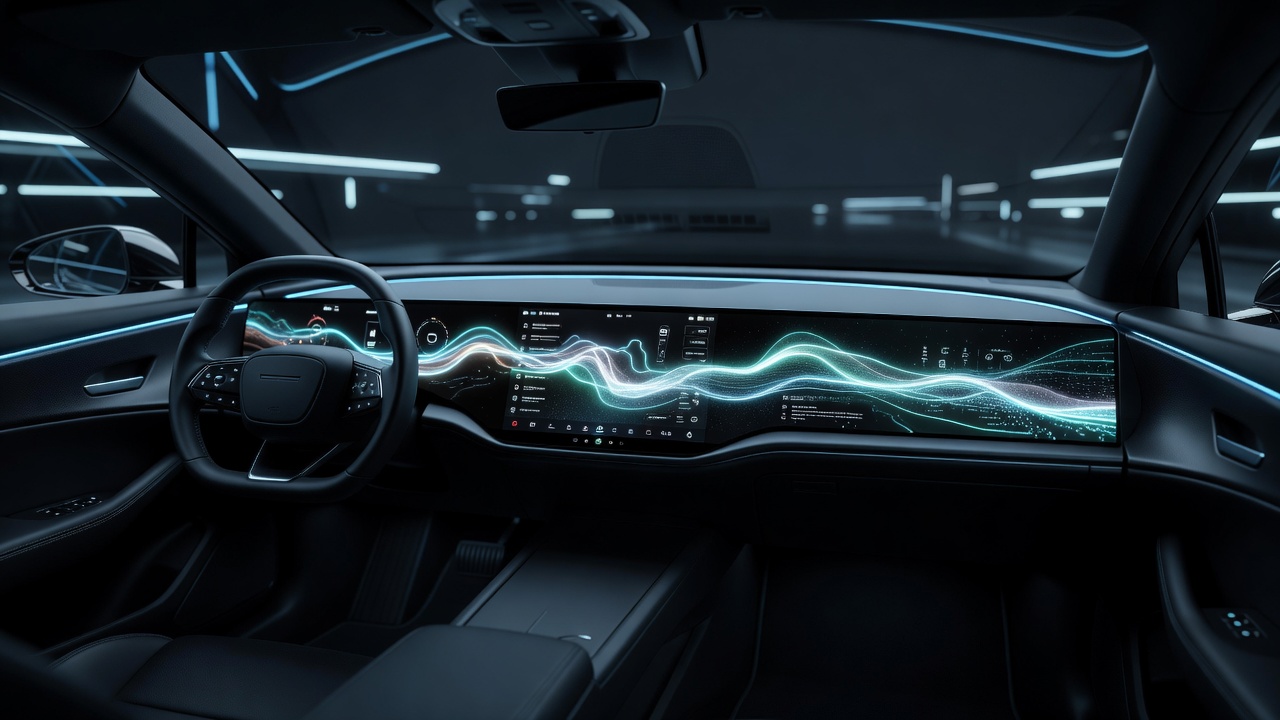
Love it or hate it, physical buttons are disappearing. The interior aesthetic of modern EVs relies heavily on massive touchscreens. We are seeing central landscape screens reaching 15 to 17 inches diagonally, passenger-side media screens, and augmented reality (AR) Heads-Up Displays (HUDs) that project navigation arrows directly onto the road ahead.
The processing power backing these screens is immense. Many top-tier EVs use desktop-grade silicon, such as AMD Ryzen processors or Qualcomm Snapdragon Automotive platforms, ensuring that maps render smoothly in 3D and that the UI responds instantly—even allowing occupants to play console-quality video games while charging.
Advanced Driver Assistance Systems (ADAS)
You can't discuss EV tech without talking about semi-autonomous driving. Because EVs rely on electronic "drive-by-wire" systems, implementing automated steering and acceleration is straightforward from an integration standpoint. The complex part is the sensor suite and the AI logic.
- Camera Vision: Networks of 8 to 12 cameras providing 360-degree visibility, fed into neural networks to identify cars, pedestrians, and lanes.
- Radar & LiDAR: While some manufacturers rely purely on vision, others incorporate LiDAR to create high-resolution 3D point clouds of the environment, drastically improving safety in fog, rain, or blinding sunlight.
- Highway Driving Assists: Systems that allow for hands-free highway driving on mapped interstates, automatically managing speed, lane keeping, and even lane changes to pass slower traffic.
It is crucial to note that no car on the market today is fully autonomous (Level 5). Driver supervision is always required. However, the systems are exceptionally good at reducing driver fatigue on long highway stretches or in stop-and-go traffic.